
Arc Flash Consulting Services

Data Collection, Electrical System Modeling, Label Application and Expert advise
Protecting personnel and facilities from electrical hazards is more than a best practice—it’s a critical requirement. Excel Engineering provides expert arc flash consulting services that help companies assess risk, maintain OSHA and NFPA 70E compliance, and implement solutions that reduce the likelihood of electrical incidents. Our licensed engineers deliver accurate, data-driven arc flash studies and customized mitigation strategies for safe, code-compliant operations.
What is an Arc Flash?
An arc flash is the light and heat produced from an arc between one live electrical conductor and ground or between two live conductors. The arc travels through ionized air, also known as plasma, which turns the normally nonconductive air into a conductive path. The plasma temperature can reach 20,000 Kelvin (or about 35,000 Fahrenheit). That is hotter than the surface of the sun!
With that extreme temperature, the “flash” is violent. High-power arc-flash faults are electrical explosions that release a great deal of energy. That energy combines radiant heat, intense light, and high-pressure waves.
When an arc flash occurs, the instantaneous temperature increase rapidly expands the air volume. The resulting pressure wave can blow you off your feet and damage or destroy anything in its wake. The accompanying radiant energy burns dramatically.
High temperatures can also change circuit components from solid to vapor. For instance, if your conductor is copper, it would instantly vaporize at this arc flash temperature. This further adds to the destructive power of the arc flash. The vaporizing copper expands to over 60,000 times its original size. This significantly increases the pressure wave.
Our Arc Flash Consulting Process
We provide a comprehensive, end-to-end arc flash study tailored to your facility’s needs. Our services include data collection, system modeling, arc flash hazard analysis, short-circuit studies, protective device evaluation, and equipment labeling for substations, switchgear, panels, motor control centers, and disconnects.
Our engineers perform on-site data collection, model the entire power distribution system and analyze incident energy levels, PPE requirements, equipment ratings, and protective device coordination to identify opportunities to improve safety and reduce arc flash risks.
Following the analysis, we apply customized NFPA 70E-compliant arc flash labels, update one-line diagrams and panel schedules based on verified field data, and provide a comprehensive final report. Deliverables include an executive summary, arc flash and short-circuit reports, TCC curves, device evaluation results, protective device settings, input data documentation, and updated system one-line drawings.
Arc Flash Studies Equipment Scope:
We can tailor the scope of the study to meet your requirements. Our typical Arc Flash study will include the following types of equipment for those portions of the power system included in the studies:
- Unit Substations.
- 480V switchgear, power panels, and motor control centers
- 480V control panels and disconnects fed from 60A or larger breakers
- 240V and 208V panels.
- 240V, 208V, and 120V control panels and disconnects fed from 60A or larger breakers
Data Collection
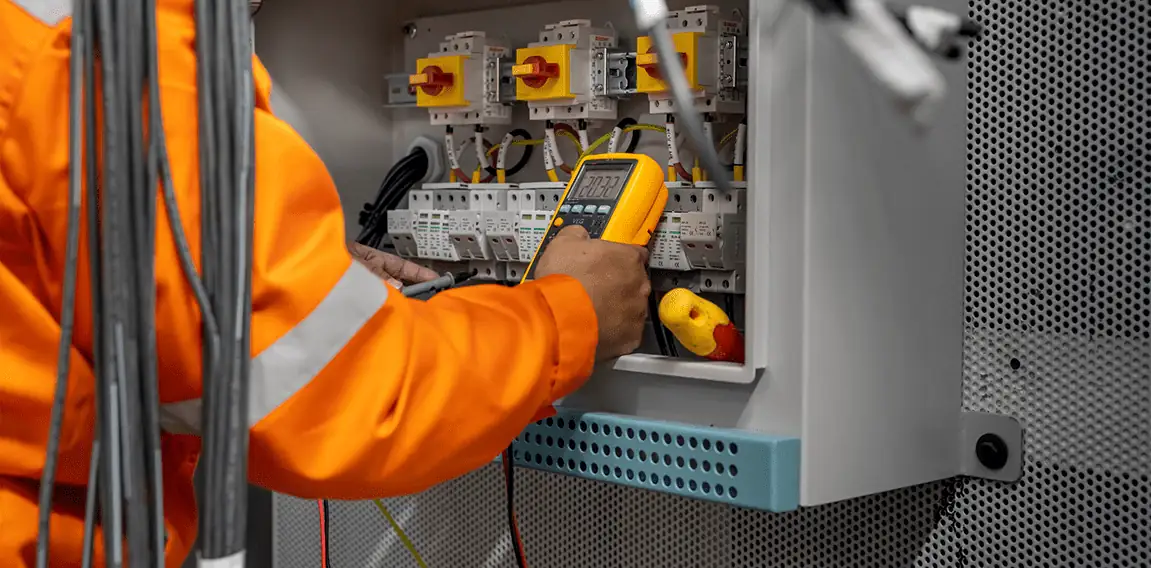
Our team will come to your site fully prepared with PPE and training to open energized electrical panels and collect data from Main and Feeder breakers and wire sizes and lengths so that we can accurately model the electrical system.
System Modeling and Arc Flash Hazard Analysis
Using industry-standard software, our engineers model your power distribution system to simulate fault conditions and calculate incident energy levels. We determine PPE requirements, calculate arc flash boundaries, and label equipment according to NFPA 70E standards.
We will model the entire power distribution system, including modeling motor contributions to accurately reflect the existing conditions, including individually modeling all motors 50HP and larger. Motors smaller than 50HP will be modeled within groups unless fed from a protective device larger than 60A and have a local disconnect requiring a label. We will also perform short-circuit and device evaluation studies with a contingency level of 250MVA for the utility system short-circuit contribution. Further analysis will be conducted for any underrated devices at the 250MVA level to determine whether they are properly rated for the actual utility contribution.
We review miscoordinated overcurrent protective devices based on the arc flash results, which flag devices with miscoordinated protective devices at the arcing fault level. We will also review main switchgear relay/breaker overcurrent settings and fuses and make recommendations in instances where changes could significantly lower arc flash incident energy levels and/or improve coordination with downstream equipment.
Labeling & Documentation
We will provide several example labels that can be customized to fit your needs. Once you select a label format and the arc flash study is complete, our team will apply the durable arc flash labels to all equipment included in the arc flash study, which will likely require inspection or maintenance while energized.
We will update CAD one-line drawings based on field information that can be safely verified, including all distribution panels, feeder information greater than 100A, conductor length, conductor size, short-circuit data, arc flash PPE category, and switchgear breaker/relay setting information. We will also update the AutoCAD panelboard schedules based on field information that can be safely verified, including updating feeder information greater than 60A, breaker setting information, and short-circuit information from the study.
Finally, we will deliver an Arc Flash Final Report that will include the following:
- Executive summary of assumptions, findings, and recommendations
- Arc flash summary report
- Short circuit summary with TCC Curves
- Device evaluation report
- Protective device settings reports
- Input Data Report
- Model one-lines
- Arc Flash Study Options Page
Frequently Asked Questions
- Service Upgrades
- Changes to Utility Fault Current
- Addition of Generators
- Installation of New Switchgear or MCCs
- Protective Device Setting Changes
- Significant Facility Expansions
- Addition or Removal of Large Motors
- IEEE 1584 - Guide for Performing Arc Flash Hazard Calculations
- NFPA 70E - Standard for Electrical Safety in the Workplace
- OSHA Electrical Safety Requirements
- National Electrical Code (NEC) Labeling Requirements
- Number of Substations, Switchboards, MCCs, and Electrical Panels
- Presence of Emergency or Standby Generators
- Availability and Accuracy of Existing Electrical Drawings
- Amount of Field Data Collection and Verification Required
- Inclusion of coordination studies, protective device setting reviews, or acr flash mitigation recommendations.
Facilities with accurate and up-to-date one-line diagrams generally require less field effort, which can help reduce project costs and schedule. After reviewing your one-line diagram, our engineers can provide a detailed scope and budget tailored to your facility.
Nee a budgetary estimate? Send us your current one-line diagram and our engineers will review your electrical distribution system to develop a scope, schedule, and budget tailored to your facility. If one-line drawings are unavailable or outdated, we can also discuss field verification options to support the study.An arc flash study not only identifies hazards within your electrical distribution system, but can also uncover opportunities to reduce incident energy levels and improve worker safety. The most effective mitigation strategy depends on the specific configuration of your electrical system and the causes of the elevated arc flash hazard.
Common arc flash mitigation methods include:- Adjusting protective device settings to reduce fault clearing times
- Replacing or upgrading obsolete breaks and protection devices
- Improving protective device coordination
- Installing zone selective interlocking (ZSI)
- Adding differential relaying or arc-resistant switchgear
- Implementing maintenance switches or energy-reducing active arc flash mitigation systems
- Modifying system configurations or operating modes
- Replacing underrated equipment identified during the study.
- Improving electrical equipment maintenance practices
- Establishing safer work procedures and employee training programs
An arc flash study is only the first step in improving electrical safety. Once an arc flash study has been completed and equipment has been labeled, employees must be trained to understand and apply the results in the field. The study provides critical information such as incident energy levels, arc flash boundaries, available fault current, and PPE requirements, but employees need training to safely use that information during maintenance, troubleshooting, and electrical work.
We recommend NFPA 70E Training immediately following an arc flash study
NFPA 70E electrical safety training teaches employees how to recognize electrical hazards, interpret arc flash labels, understand shock and arc flash boundaries, perform risk assessments, and select the appropriate personal protective equipment (PPE) based on incident energy levels or PPE categories. Training also covers safe work practices, lockout/tagout procedures, electrically safe work conditions, and the responsibilities of qualified electrical workers. Employees who work on or near energized electrical equipment should receive NFPA 70E training that specifically addresses how to use arc flash study results, including reading equipment labels, understanding arc flash boundaries, determining PPE requirements, and following established electrical safety procedures. Workers must also understand the relationship between electrical hazards and potential injuries so they can make informed safety decisions in the field. Organizations should also ensure that their electrical safety program, procedures, and employee training align with the findings of the arc flash study. This helps employees consistently apply the study results and maintain compliance with electrical safety requirements.One of the most common questions when planning an arc flash study is determining where to draw the line. Evaluating every piece of electrical equipment in a facility is possible, but it may not always be practical or cost-effective
One of the most common questions when planning an arc flash study is determining where to draw the line. Evaluating every piece of electrical equipment in a facility is possible, but it may not always be practical or cost-effective
The appropriate study scope depends on your facility, equipment, operating practices, and safety objectives. According to NFPA 70E, arc flash labels are required on equipment that is likely to require examination, adjustment, servicing, or maintenance while energized. As a result, the most important consideration is identifying the equipment your personnel may interact with while energized. Common arc flash study scopes include:- Distribution equipment only (switchgear, switchboards, MCCs, major distribution panels, and substations)
- Equipment fed from 40 amp or larger protective devices
- All equipment likely to require an energized work or troubleshooting
- Facility-wide studies that include distribution and utilization equipment
Our experience has shown that evaluating equipment fed from 40 amp or larger protective devices captures nearly all equipment that may present a meaningful arc flash hazard while maintaining a reasonable project budget. It is very uncommon for equipment below the 40-amp threshold to exceed 1.2 cal/cm², which is the incident energy level commonly associated with the onset of an arc flash hazard requiring arc-rated PPE.
However, there is no universal cutoff that applies to every facility. Factors such as available fault current, transformer size, conductor lengths, and protective device characteristics can affect incident energy levels. For that reason, facilities with unique electrical systems, high available fault current, or specific client standards may benefit from a broader scope of work.We're ready to help with your next Arc Flash Study.
Ensure electrical safety and NFPA 70E compliance with expert arc flash consulting and hazard analysis from Excel Engineering. Whether you need a complete arc flash study or a 5-year review, our team is ready to get to work.
Contact us now!
"*" indicates required fields